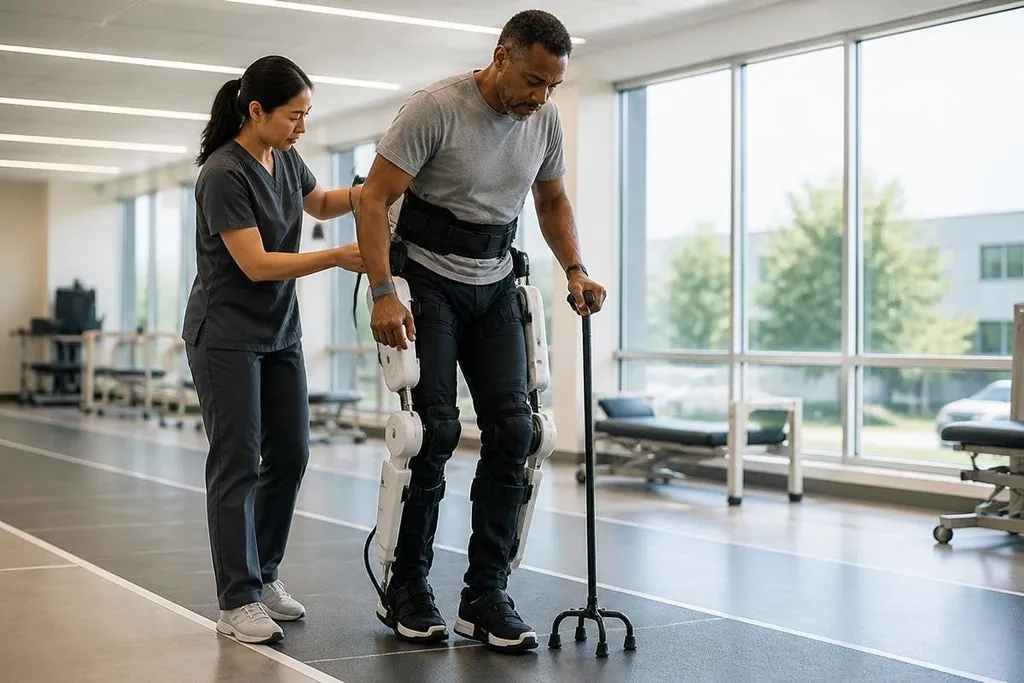
An exoskeleton adds motors, springs, or rigid supports around a person’s legs, hips, or upper body. It reads movement through sensors and adds force where the wearer needs help, which changes mobility from a fixed aid into active assistance.
- Support for walking, lifting, or standing
- Sensors that read joint movement and force
- Limits set by fit, battery life, and clinical evidence
How the robot adds force
An exoskeleton works beside the body rather than carrying a person like a vehicle. A control system reads signals from joint sensors, foot pressure sensors, or motion sensors, then tells an actuator when to assist.
An actuator is the part that creates movement. It may be an electric motor, a pneumatic system, or a spring that stores and releases energy. The joint still needs to move with the person, so timing matters as much as motor strength.
A hip device may add force as the wearer begins a step. A knee device can help the leg extend during standing. A back-support system can reduce the load on the lower body during repeated lifting.
These tasks need different control settings, so one design can't cover every use. The robot must also stop helping at the right moment. If assistance continues after the wearer has finished a movement, the device can pull against the body or affect balance. That is why fit, joint alignment, and control software matter as much as the frame.
Medical mobility and rehabilitation
Medical exoskeletons can help a person practise standing or walking after an injury. The robot supports part of the movement while the person supplies the rest, giving a therapist a way to adjust the amount of help during a session.
That setup can change as strength returns. A therapist may start with more support, then reduce it as the wearer gains control. The useful measure is not a dramatic demonstration; it is whether the person can repeat a task with better control and less help over time.
Evidence needs careful reading here. A device may help someone take steps during supervised training without proving that they will walk independently outside the clinic. Cost, fitting time, medical approval, and access to trained staff also shape who can use it.
A clinic result says little about a factory shift, where the robot must support repeated lifting without restricting the worker. A dated report on mobility robotics and exoskeletons should name the maker, trial setting, and measured result before you judge the move into industrial support.
Industrial support and worker safety
Industrial exoskeletons take a different path. They may support the back, shoulders, or arms during repeated work, such as holding a tool overhead or handling loads near the floor.
The device does not remove the load. It changes where some of the force travels through the body and frame. That can reduce strain during a specific task, but it does not fix a poorly designed workstation or a load that is too heavy to handle safely.
The work area also matters. A rigid frame can catch on shelves, seats, ladders, or narrow spaces. A powered unit needs charging, inspection, and a plan for faults. Workers need training so they can remove the device quickly and know when its assistance feels wrong.
The strongest case is a repeated task with a clear posture and movement pattern. Jobs that require frequent turns, stairs, crawling, or quick changes may fit a wearable robot poorly.
What still limits adoption
Battery weight remains a design trade-off. A larger battery can run the motors longer, but it adds weight that the wearer must carry. A smaller system may feel easier to wear while giving less assistance or shorter operating time.
Fit creates another limit. People differ in leg length, hip width, shoulder position, and movement pattern. A device that fits one wearer well can place pressure on another person’s joints, so setup cannot be treated as a one-time detail.
The open question is long-term use. A short trial can show that a robot assists one movement, but it may not show how the body responds after months of work or therapy. I’d judge an exoskeleton by repeated task results and safe use over time, not by how much weight it lifts in a demo.
A practical buying and trial checklist
Use these checks before a clinic or workplace commits to a device:
- Define the task: name the movement, load, duration, and space where the robot will work.
- Check the user fit: measure the wearer and test pressure points during the full movement.
- Set the help level: confirm who changes the assistance and how the setting is recorded.
- Plan the fault response: practise stopping, removing, and storing the device without power.
- Measure the result: track task time, fatigue, errors, pain reports, and missed safety stops.
- Price the full setup: include training, fitting, charging, repairs, and staff time.
A suitable exoskeleton should make a defined task safer or easier to repeat, with evidence from the people who use it. The next useful proof is not a louder demo; it is months of safe work or therapy with clear results.